·
How to Get an ITIN Number in 2026 (Free)

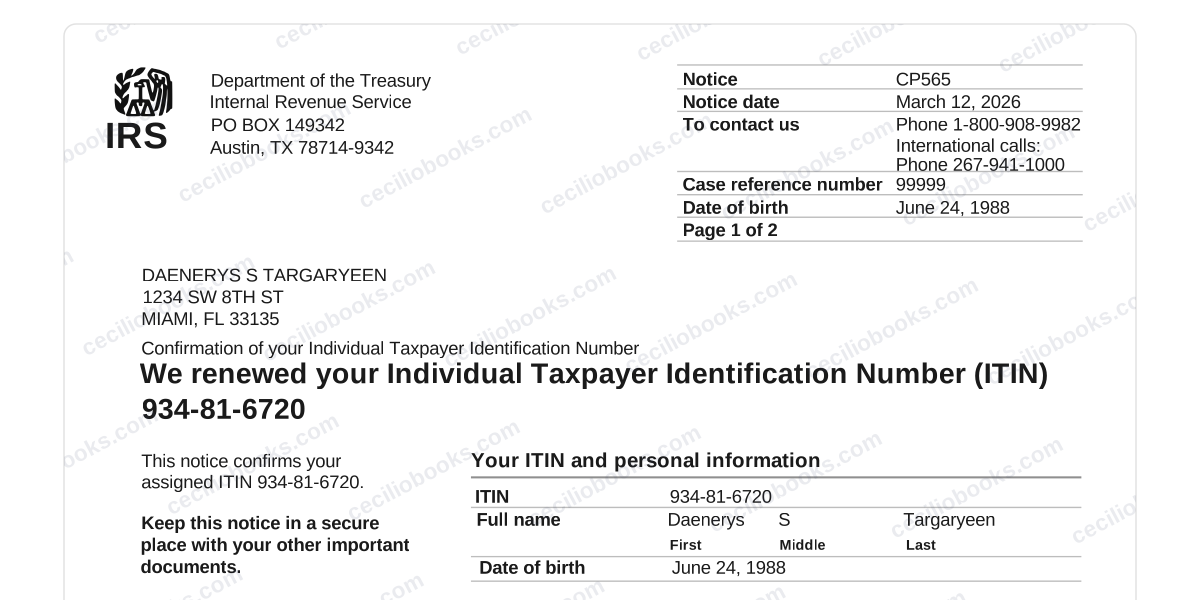
The ITIN is a 9-digit tax identification number issued by the Internal Revenue Service (IRS), the tax authority of the United States. It lets people who can’t get a Social Security Number (SSN) file taxes and participate in the American financial system, even without living in the US. Applying is free, you can do it yourself, and the IRS usually responds in about 7 weeks.
Quick summary (what you need to know)
- What it is: the IRS tax number for people who can’t get an SSN.
- Cost: free when you apply directly with the IRS.
- 3 requirements: Form W-7 + a tax return + 2 original ID documents.
- Timeline: ~7 weeks (9 to 11 weeks during tax season or applying from abroad).
- What it unlocks: credit cards, financing, bank accounts, brokerage accounts, and more.
In this guide you’ll learn what an ITIN is, how to apply step by step, and the main advantages of having one to access the US financial system, even if you live outside the country.
What is an ITIN number?
ITIN stands for Individual Taxpayer Identification Number: a tax processing number issued by the Internal Revenue Service (IRS) for people who need a US taxpayer number but don’t have, and aren’t eligible for, an SSN.
It was created in 1996: the Treasury regulation that established the ITIN (Treasury Decision 8671) took effect on May 29, 1996, and the IRS began accepting applications (Form W-7) on July 1, 1996. The goal was to bring foreign nationals who can’t receive an SSN into the country’s tax code (the Internal Revenue Code), allowing them to file income tax returns.
The ITIN number has 9 digits and always starts with 9, in the format 9XX-XX-XXXX. The ITIN is not an identity document or a work permit in the US: it exists exclusively for tax purposes.
After approval, the IRS sends your number in a letter called the CP565 Notice (understanding your CP565 notice).
A common question is how the ITIN compares to the other US tax numbers. The distinction is simple: each number serves a specific group and purpose.
| Number | Who it’s for | What it’s used for |
|---|---|---|
| SSN (Social Security Number) | Citizens and residents authorized to work | Work, benefits, and taxes |
| ITIN | People not eligible for an SSN who have a tax obligation | Filing taxes and accessing financial services |
| EIN (Employer Identification Number) | Businesses | Identifying a business to the IRS |
Why do I need an ITIN?
You need an ITIN when you have tax obligations in the US but aren’t eligible for an SSN. The SSN covers most people with residency authorization; everyone else uses the ITIN to file taxes and prove their identity to banks and institutions. In practice, it’s the tax ID for immigrants and foreign nationals in the United States.
Who needs an ITIN
- Spouses of Green Card holders or temporary visa holders (such as the H4 visa).
- Undocumented immigrants who live and earn income in the United States.
- Entrepreneurs who open a US company, even without living in the country.
- People who stay in the United States for more than 6 months.
The process is the same regardless of nationality.
When the ITIN is mandatory
In four practical situations, the ITIN stops being optional:
- Filing your tax return. If you earn income in the US and don’t have an SSN, you file your federal return with an ITIN.
- Working for yourself. In painting, construction, carpentry, or cleaning, the hiring company usually requires the number to pay you and report to the IRS.
- Claiming tax credits. Credits like the Child and Dependent Care Credit require a taxpayer number (see the 2025 rules below).
- Buying property in the US. Nonresident foreign nationals use the ITIN for the tax filings tied to the property.
The ITIN is not a visa or a work permit. Even so, the IRS requires you to pay your taxes if you have income in the United States.
What are the advantages of having an ITIN?
The ITIN opens doors in the American financial system that stay closed to anyone with only a passport. It shows banks that the US government has recognized your identity and that your taxes are in order. There are eight practical benefits, split across three fronts.
Banks, credit cards, and credit history
- Bank account. Traditional and online banks accept the ITIN to open an account. Online banks usually pay better interest on your savings.
- Credit card. With only a passport, some banks offer just secured cards (which require a deposit as collateral). With an ITIN, you can access better cards with cashback, miles, and rental car insurance.
- Credit Score. Using an account and card in your name builds your credit score. That score determines the interest rates banks will offer you in the future.
Financing, loans, and housing
- Financing a car or home. The bank checks your credit history and can offer lower interest rates on the loan.
- Personal loan. You can apply directly on online banks’ websites, without visiting a branch.
- Renting a home. Good apartments run a credit check. Property managers and platforms like Zillow accept an SSN or ITIN for the background check.
Work and investing
- Work apps. Upwork, Amazon Flex, and DoorDash may ask for an ITIN for registration and payment.
- Brokerage accounts. Major US brokerages accept an ITIN to invest in stocks and bonds. This is probably the biggest benefit of all.
How do I apply for an ITIN?
To apply for an ITIN, you must meet 3 mandatory requirements for the IRS to process your application:
- Fill out Form W-7.
- Attach a US tax return.
- Provide two original identification documents, such as a passport and a national ID.
The IRS does not require you to live in the United States to apply: you can file from any country. You mail Form W-7, the tax return, proof of identity, and the foreign status documents to:
Internal Revenue Service Austin Service Center ITIN Operation P.O. Box 149342 Austin, TX 78714-9342
According to the IRS, these are the processing timelines:
| Situation | Timeline |
|---|---|
| Standard processing | About 7 weeks |
| Tax season (Jan 15 to Apr 30) | 9 to 11 weeks |
| Application filed from abroad | 9 to 11 weeks |
| Return of original documents | Up to 60 days |
Requirement 1: Form W-7
You apply with Form W-7 (Application for IRS Individual Taxpayer Identification Number), available as a PDF on the IRS website. You can fill it out on a computer or print it and complete it by hand.
The application is free and you can do it yourself, without hiring a lawyer or accountant. If you fill something out wrong, the application gets rejected, but there’s no penalty: you can resubmit the form as many times as needed.
The W-7 asks for personal information such as your full name, address, date of birth, country of citizenship, and, if you have one, the tax identification number from your home country.
Requirement 2: a tax return
The IRS requires you to attach a tax return to your W-7 to prove you actually need the ITIN. Even people with no income to report must file a return that meets IRS requirements. This is the step that raises the most questions in the application. (We’re preparing a dedicated guide to filing a US tax return for this case.)
Requirement 3: identification and supporting documents
You must provide original documents that prove two things: your identity and your foreign status. The IRS accepts 13 documents for this, and the passport is the only one that proves both requirements on its own. Here’s what to send based on your situation:
| Your situation | What to send |
|---|---|
| Passport with a US visa (including tourist or student) | Original passport + tax return |
| Passport without a valid visa | Original passport + tax return + national ID (such as an ID card, voter registration card, or driver’s license) + certified English translation |
According to the Form W-7 instructions, the IRS may request the certified translation after you file. It isn’t always mandatory in the initial application, but attaching it from the start avoids processing delays. In the United States, there is no government-licensed “sworn translator” (a figure that exists in many other countries): a certified translation is simply a translation accompanied by a signed statement from the translator attesting that the content is complete and accurate, with no validation needed from any official agency or consulate.
Documents must be originals or copies certified by the issuing agency (for passports, your country’s consulate or embassy) or by accredited Acceptance Agents listed on the IRS website, who may charge varying fees. At least one document must include your photo, except for dependents under 14 (or under 18 if they’re students).
Heads up: 2025 changes to credits for ITIN holders
Starting in tax year 2025, the American law known as the One Big Beautiful Bill (OBBB), signed in July 2025, changed credit rules that directly affect people who only have an ITIN.
The Child Tax Credit (CTC) rose to $2,200 per child in 2025 (with up to $1,700 refundable via the Additional Child Tax Credit), now permanent and adjusted for inflation in the following years. The key change: the child must have a valid SSN (an ITIN is not enough), and at least one of the filers must also have a valid SSN issued by the return’s due date.
In practice, families where the adults only have an ITIN can still use the nonrefundable CTC to reduce the tax they owe, but they won’t receive the amount as a refund. Since these rules are recent, confirm the requirements on the official Child Tax Credit page before counting on the credit.
Sources
All sources were accessed on July 8, 2026:
- IRS — How to apply for an ITIN
- IRS — ITIN supporting documents
- IRS — Instructions for Form W-7 (Rev. 12/2024)
- IRS — Topic no. 857, ITIN
- IRS — Understanding your CP565 notice
- IRS — Additional ITIN information
- IRS / U.S. Treasury — Treasury Decision 8671, Taxpayer Identifying Numbers (1996) — the regulation that established the ITIN (effective May 29, 1996; W-7 accepted starting July 1, 1996)
- IRS — ITIN documentation FAQs
- IRS — Child Tax Credit — $2,200 CTC and $1,700 refundable portion (tax year 2025)
- TaxAct — OBBB Limits Tax Credits for ITIN Filers Without SSN
- Bipartisan Policy Center — How the OBBB Changes to the Child Tax Credit Will Impact Families
